Automotive Fixtures may look like steel frames, clamps, and locating pins, but small design choices can shape a production line’s accuracy and pace. A fixture must hold parts consistently, allow clear tool access, and withstand repeated loading. On a busy shop floor, a misplaced datum or awkward clamp can slow operators and complicate inspection.
This guide compares ten suppliers serving global buyers, with attention to engineering support, build quality, customization, delivery coordination, and after-sales service. Taiichi Ohno, the Toyota manufacturing engineer, wrote, “Where there is no standard, there can be no kaizen.” His principle offers a useful lens: buyers should ask how suppliers document repeatability, manage design changes, and validate a fixture before production. Ask for specifics. Sample inspection records and realistic project references can be more useful than polished claims.
Supplier fit depends on the application. A body-in-white welding fixture faces different demands from an assembly nest or a checking fixture. Buyers should examine material choices, datum strategy, clamp access, changeover needs, and maintenance plans. Global projects add practical questions: Can the supplier coordinate across time zones? Is local technical support available? Are drawings and acceptance criteria clearly agreed? No shortlist is perfect. Supplier capabilities vary, and published information may not reveal the full picture. Use the rankings as a starting point, then verify each candidate against your parts, process, and timeline.
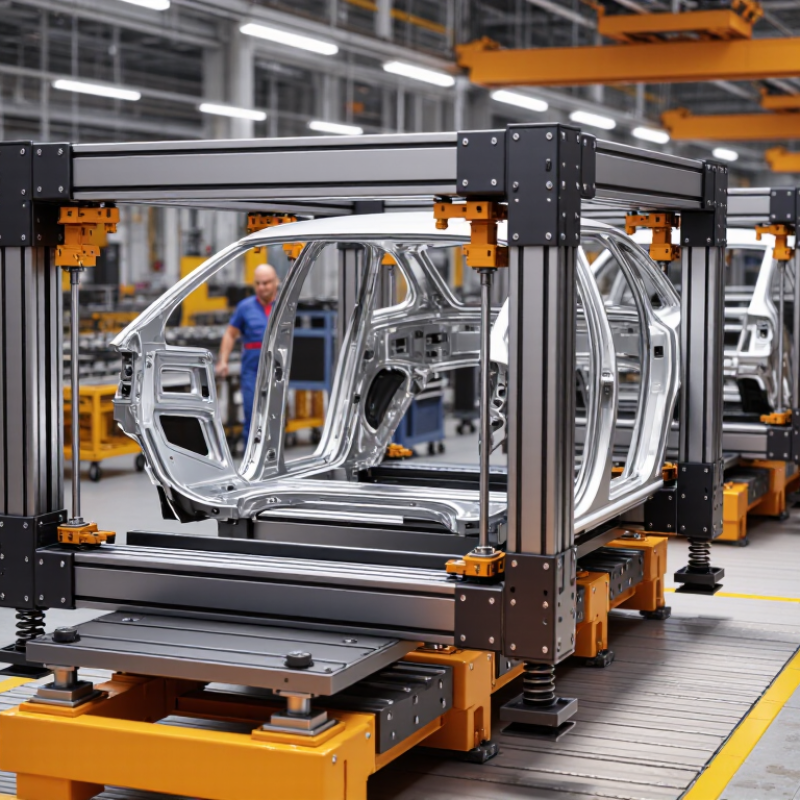
Automotive fixtures are purpose-built tools that hold, locate, or guide vehicle parts during production. A body panel fixture, for example, keeps sheet metal in position while operators check dimensions or join components. Clamps, locating pins, and support blocks help control movement. Small shifts matter. A misaligned part can affect later assembly, even when the original error looks minor.
Fixtures also support repeatable work on welding, inspection, and final assembly stations. Their design should match the part, process, and expected production rate. Engineers often review access for tools and hands, since a fixture that holds accurately but blocks safe operation creates problems. Clear datum points and robust materials can improve consistency, but no fixture stays accurate forever. Wear, heat, and repeated clamping may change its performance. Regular checks with gauges can reveal drift before it spreads through a batch.
Good fixture planning includes the people who use and maintain the equipment. Operators can spot awkward loading or visibility issues that drawings may miss. Maintenance teams need access to replaceable pins and clamps. There is a trade-off: adding more locating points may improve control, yet make loading slower. The right balance depends on the component and the process, and it may take real production trials to find it.
The table compares common supplier capability areas, not named or ranked companies.
| No. | Supplier Capability Area | Typical Fixture or Equipment | Role in Vehicle Manufacturing | Key Buyer Evaluation Points |
|---|---|---|---|---|
| 1 | Body-in-white assembly tooling | Welding fixtures, locating nests, and assembly stations | Holds and locates body panels and structural parts during joining and assembly. | Datum strategy, access for welding, repeatability, guarding, and integration with the production line. |
| 2 | Checking and inspection fixtures | Checking fixtures, gauges, and inspection nests | Supports dimensional checks of parts or assemblies against defined reference points. | Measurement method, calibration needs, datum repeatability, inspection access, and documentation. |
| 3 | Machining workholding | Dedicated clamps, modular fixtures, and machine pallets | Secures components during machining while providing tool and chip clearance. | Part stability, clamping sequence, machine interface, tool access, and changeover requirements. |
| 4 | Robotic welding and handling tooling | Robot-compatible fixtures, positioners, and end effectors | Locates parts or enables robotic gripping and movement in automated cells. | Robot reach, collision checks, cable routing, safe access, and cell-interface requirements. |
| 5 | Plastic-part assembly tooling | Trim-panel nests, locator fixtures, and assembly aids | Supports fit-up and assembly of interior and exterior molded components. | Part-surface protection, locating without distortion, ergonomic loading, and variant coverage. |
| 6 | Powertrain and battery assembly tooling | Engine, transmission, and battery-module fixtures | Positions heavy or complex assemblies for joining, testing, or installation operations. | Load rating, lifting and securing method, electrical safety needs, and assembly access. |
| 7 | Weld-gun and process tooling | Electrode holders, weld-gun mounts, and process-specific fixtures | Helps maintain the required tool position and access during joining operations. | Tool compatibility, serviceability, process clearance, wear parts, and maintenance access. |
| 8 | Flexible and modular fixturing | Reusable baseplates, adjustable locators, and modular clamps | Accommodates multiple parts or product variants with configurable components. | Reconfiguration effort, rigidity, locator repeatability, component availability, and setup instructions. |
| 9 | Prototype and low-volume tooling | Prototype nests, soft fixtures, and adjustable assembly aids | Enables evaluation builds and early assembly work before production tooling is finalized. | Design-change flexibility, lead time, repairability, and suitability for the intended build volume. |
| 10 | Fixture integration and lifecycle support | Integrated fixture systems, spare components, and maintenance support | Connects tooling with production equipment and helps keep fixtures serviceable in operation. | Interface drawings, installation support, spare-parts planning, service documentation, and export logistics. |

A fixture supplier should prove repeatability, not just quote tight tolerances. Ask for inspection records showing locating-pin position, clamp force, and measurement variation across repeated setups. Request a sample run using your part or a representative geometry. Fit matters. A polished drawing alone cannot show whether operators can load the fixture quickly or reach every clamp safely.
Flexibility deserves close review. The International Energy Agency’s Global EV Outlook 2024 reports nearly 14 million electric cars sold in 2023, about 18% of global car sales. That shift can bring new part variants and changing production needs. Evaluate modular interfaces, changeover time, spare-part availability, and support across your operating regions. Deloitte’s 2019 smart-manufacturing survey found that 86% of surveyed manufacturers expected smart-factory initiatives to drive competitiveness. For fixture buyers, that makes data readiness practical: check whether the supplier can provide calibration records and usable digital documentation.
A supplier audit should include the workshop, not only a presentation. Watch a technician assemble a fixture, verify its datums, and explain the maintenance plan. Ask how engineering changes are controlled and how delivery risks are communicated. No scorecard is perfect. A low price may hide slow replacement support, while an impressive automation claim may not fit your line. Record these trade-offs, and test the supplier against your actual production constraints.
For global buyers, market coverage means more than a supplier’s list of export destinations. It includes practical access to engineering support, spare parts, and replacement components after installation. A fixture may pass a factory acceptance check, yet still cause delays if local technicians cannot obtain a worn locator pin. Ask where service staff are based, which time zones they cover, and how quickly critical parts can ship. Distance matters. So does clear communication.
Supplier selection should connect technical fit with delivery risk. Request drawings, material specifications, inspection records, and examples of comparable automotive projects. Confirm how the supplier controls dimensional changes, protects parts during transport, and reports deviations. These details reveal more than a polished sales presentation. Compare lead times with your production schedule, including customs handling and installation support. Then review total cost: tooling, freight, commissioning, maintenance, and possible downtime. A low quote can become expensive. It happens.
Global buyers can also test collaboration before placing a large order. Share a realistic change request and observe how clearly the team documents its response. Check that units, tolerances, and revision numbers stay consistent across documents. No checklist removes uncertainty; some evaluations will miss a problem. Still, a site visit or live design review can expose assumptions early, especially around safety clearances, operator access, and line layout.
Global buyers should compare automotive fixture suppliers by process expertise, measurement discipline, and support after installation. The International Federation of Robotics reported about 135,000 industrial robots installed in automotive production worldwide in 2023 (World Robotics 2024). That scale makes robot-ready tooling, repeatable locating points, and safe access practical selection criteria—not just brochure claims.
A useful supplier landscape includes ten specialties: body-in-white welding fixtures for stable panel location; checking fixtures for dimensional verification; assembly fixtures for repeatable operator tasks; powertrain fixtures for heavy components; battery-pack fixtures for controlled positioning; modular tooling for changing vehicle platforms; ergonomic manual fixtures for reach and handling; robotic end-effectors for automated gripping; gauges and metrology fixtures for inspection; and turnkey integrators coordinating tooling, controls, and commissioning. These are capability profiles, not a verified ranking of individual companies.
Ask suppliers for sample inspection reports, tolerance plans, material specifications, and documented acceptance tests. A fixture may look precise on a drawing yet drift after repeated clamping. Ask how wear points are replaced. Also review response times, spare-part availability, and experience with your process. A small pilot run can reveal access problems that simulations miss. Honestly, no single supplier leads every category; performance depends on the part, production volume, and plant conditions.
Global vehicle production provides context for automotive fixture demand. The chart shows the ten largest vehicle-producing countries in 2023; it does not rank fixture suppliers.
China produced the most vehicles in 2023, followed by the United States and Japan. Production volumes are a market-size indicator, not a direct measure of fixture purchasing.
Source: International Organization of Motor Vehicle Manufacturers (OICA), 2023 production statistics.
Global buyers should compare fixture suppliers by process capability, not catalog size. The International Federation of Robotics’ World Robotics 2024 report records about 135,000 industrial robot installations in automotive manufacturing during 2023. That scale makes repeatable locating, robot access, and quick changeovers practical selection criteria. A supplier experienced in body-in-white welding may excel at rigid, multi-point fixtures, while another may better support inspection nests or flexible assembly stations. These are different strengths.
Application fit shows up on the shop floor. Check whether the supplier can document datum strategy, clamp sequencing, tolerance validation, and maintenance access. Ask for sample inspection records and realistic changeover times. For high-mix lines, modular locators can reduce rework between variants; dedicated fixtures may offer steadier cycle times for long runs. Fit matters. Yet modularity can add interfaces that need careful control.
OICA reported approximately 93.5 million motor vehicles produced worldwide in 2023, underscoring the range of production scales buyers must serve. Large programs may prioritize global engineering support and spare-part availability. Smaller plants may value local service, simpler tooling, and clear commissioning plans. Compare suppliers using the same part, tolerance, cycle-time, and service assumptions. A polished quotation can still hide gaps in validation detail; that deserves a closer look.