China has become an important sourcing base for industrial welding equipment and production systems. The International Federation of Robotics’ World Robotics 2024 report recorded 276,288 industrial robot installations in China in 2023, representing 51% of global installations. That is a useful signal. It reflects automation demand, not welding-table sales.
The distinction matters. Robot installation figures do not rank Welding Fixture Tables suppliers or verify product quality. Buyers still need to compare practical details: tabletop flatness, hole spacing, load capacity, clamping options, and compatibility with robotic cells. A fixture table may look solid in a catalog yet perform poorly when repeated setups expose small alignment errors. That happens.
This guide examines suppliers in China through product range, manufacturing capabilities, quality documentation, customization, delivery support, and export experience. Where available, buyers should request inspection records, material specifications, and references for comparable applications. These checks help distinguish established manufacturers from trading companies, though supplier roles can overlap. No single ranking fits every workshop. A small fabrication shop may prioritize fast delivery and simple clamps; an automated production line may need tighter tolerances and dependable integration support. The comparisons ahead aim to make those differences clearer, while recognizing that public data on this product category remains limited.
Types of Welding Fixture Tables Supplied in China
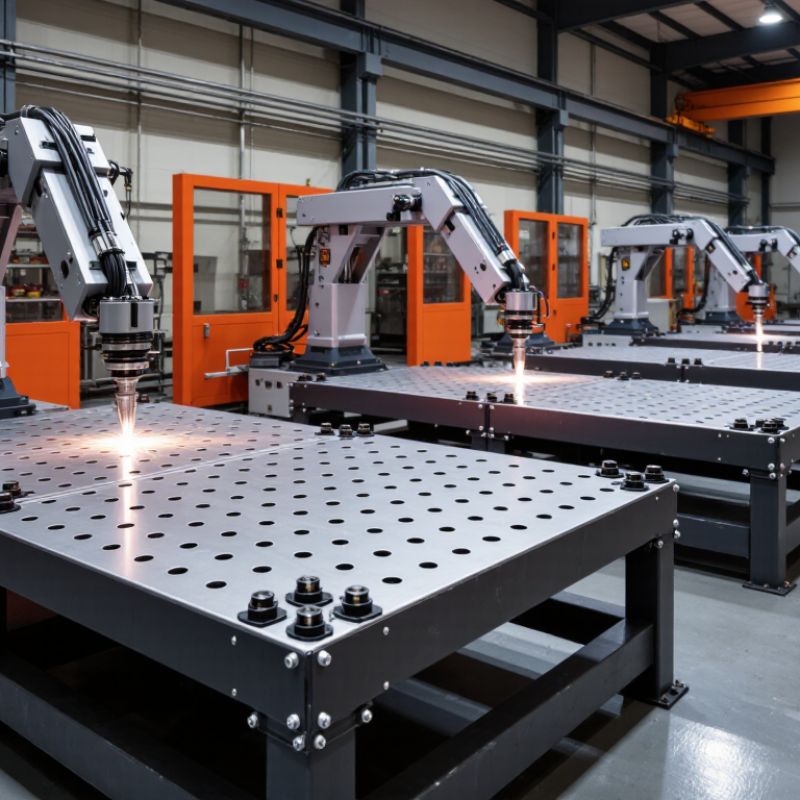
Chinese suppliers commonly offer modular, fixed, and custom welding fixture tables. Modular tables use hole grids or slots to position clamps, stops, and locating pins. They suit changing jobs and small production batches. Fixed tables have dedicated tooling for repeat assemblies. They can be efficient, but offer less flexibility when product dimensions change. Three-dimensional modular systems add side and end surfaces, helping hold frames and box-shaped parts at right angles.
Table size, load rating, surface hardness, and hole accuracy affect daily use. For example, a large steel frame needs a rigid table that resists deflection under its weight. Check the grid spacing and clamping accessories against the parts being welded. Ask suppliers for drawings, inspection details, and a sample layout before ordering. A modular table can save setup time, but only when operators keep its locating pins clean. That detail is easy to overlook.
Tips: Confirm the table’s rated load and working height. Check whether clamps, stops, and pins are included. If possible, test a representative assembly before purchase. Catalog dimensions may look suitable, yet real components can reveal awkward access or clamp interference. That happens.

Modular welding tables are commonly offered with 16 mm or 28 mm fixture-hole systems. The chart compares their nominal hole diameters, not supplier market share.
Tables may use a 2D layout with holes on the top surface or a 3D layout with holes on multiple faces. Availability and exact specifications vary by manufacturer.
A useful comparison starts with evidence, not a supplier’s catalog. Grand View Research estimated the global welding products market at USD 15.33 billion in 2023, with projected growth through 2030. This is market context, not proof that any individual supplier is qualified. Ask China-based suppliers for table drawings, steel specifications, load ratings, and inspection records. Check whether the hole grid and clamping accessories match your actual fixture plan. Small details matter. Request flatness measurements and calibration records, then confirm how measurements were taken.
A sample inspection can reveal more than polished product photos. Check machined surfaces, hole spacing, weld distortion, and whether clamps seat firmly without rocking. Ask for a trial assembly or a short video showing the table under load. Confirm production lead time, packaging, spare-part availability, and how defects are handled. ISO 9001 certification may support confidence in documented processes, but it does not replace product-specific checks. A buyer’s checklist can still miss a practical issue: a table may meet its drawing yet prove awkward to reposition on the shop floor. Share your intended use and request written acceptance criteria before ordering. Keep the conversation specific, and compare evidence across suppliers rather than relying on broad quality claims.
China’s welding fixture table suppliers often specialize in different parts of the job. Some focus on modular tables with a regular hole grid, interchangeable clamps, and adjustable stops. These suit workshops that handle frequent product changes. Others build heavy-duty fixtures for repeat production, where thicker plates and reinforced frames help control movement during welding. The right specialty depends on workpiece size, production volume, and required positioning accuracy.
A supplier with fixture-engineering experience should ask about your parts, weld sequence, and clamping points before recommending a setup. Share drawings or sample dimensions, then check whether the proposed table can accommodate your clamps and accessories. Ask about flatness inspection, surface treatment, load capacity, and replacement parts. Useful evidence may include inspection records and a sample setup—not just polished catalog photos. Details matter.
Some manufacturers offer custom tables and dedicated fixtures for a specific assembly. This can save setup time, but changes to the part may require new tooling. Modular suppliers offer more flexibility, though loose accessories can complicate changeovers. There is no perfect choice. Compare a small trial fixture against your actual workflow, and watch for access around the weld seam, clamp clearance, and table deflection under load. One overlooked dimension can create delays.
China’s welding fixture table suppliers differ less by catalog size than by engineering control. The International Federation of Robotics reported
541,302 industrial robot installations worldwide in 2023, with 70% installed in Asia.
That growth makes fixture repeatability more important in automated welding cells. The report measures robot installations, not table quality, so it should not be used to rank suppliers.
Ask suppliers for a sample inspection record showing table flatness, hole-pitch accuracy, and coating thickness. Check how they control material batches and machining changes.
For customization, compare their response to a real drawing: Can they adjust slot spacing, add locating pins, or match an existing clamping layout? A short sample build can reveal more than a polished catalog.
Small details matter. I would not treat a fast quotation as proof of capability; I have seen specifications look clear while leaving tolerance limits vague. Require written acceptance criteria and a revision-controlled drawing before production.
Selecting a welding fixture table supplier starts with the workpiece, not the catalog. Note the largest part, its weight, and the weld positions operators use every day. A table that looks substantial may still flex under an uneven load. Ask for flatness tolerances, material details, and load ratings in writing. Small details matter.
Check the hole pattern, fixture compatibility, and available clamps against your actual jigs. If parts change often, modular accessories can reduce setup time. Request a sample or a dimensional inspection report, especially when table accuracy affects repeatability. A smooth finish is useful, but it does not prove the surface will stay true after heavy use. That distinction is easy to overlook.
Supplier communication deserves a practical test. Send a drawing with one unusual dimension and ask how it will be checked. Clear answers about machining, inspection, packaging, and lead time are more useful than broad promises. Ask what happens if a delivered table misses specification. No checklist catches everything, and delivery estimates can shift. Confirm the details that would disrupt your production schedule before placing an order.
| Supplier Type | Typical Best Fit | Capabilities to Look For | Key Questions to Ask | Evidence to Verify | Potential Trade-Off |
|---|---|---|---|---|---|
| Modular fixturing-table manufacturer | Repeated production, flexible workholding, and jobs requiring frequent fixture changes. | Compatible table and accessory system; documented hole or grid layout; clamping, locating, and support components; replacement-part availability. | Which accessories fit this table system? What are the documented flatness, load, and dimensional tolerances? Are compatible parts available individually? | Dimensioned drawings, material and finish specifications, inspection records, load guidance, and an accessory compatibility list. | System-specific accessories may limit interchangeability with other table systems. |
| Custom fixture fabricator | Dedicated products, irregular workpieces, or assemblies that need application-specific locating and clamping. | Fixture design, prototype development, machining and fabrication, datum planning, and revision control. | How will the fixture locate the part and control weld distortion? Who approves the design before production? How are design changes handled? | Design drawings, acceptance criteria, inspection results, sample-build records, and documented revision history. | A custom fixture can be less adaptable if the product or process changes. |
| Welding automation integrator | Robot or automated welding cells where the fixture must work with the machine, safety system, and production sequence. | Robot-cell integration, fixture interfaces, positioners where required, safety coordination, commissioning, and operator training. | Who is responsible for the complete cell interface? How are reach, cable clearance, clamping sequence, and safety interlocks validated? | Interface drawings, risk-assessment documentation, commissioning plan, cycle-time assumptions, and service-support terms. | A broader integration scope may require more coordination and a longer project schedule. |
| Industrial tooling distributor | Standard tables and accessories, replacement components, or buyers who need access to several product ranges. | Product selection support, local stock or stated lead times, spare-part identification, and clear warranty handling. | Is the distributor authorized for the supplied products? Are items stocked or made to order? Who handles technical questions and warranty claims? | Current quotations, product datasheets, written delivery commitments, warranty terms, and traceable product documentation. | Design customization and direct engineering support may depend on the original manufacturer. |
| Supplier with export and project support | Overseas buyers needing coordinated packaging, shipping documents, communication, and after-sales support. | Export packing, shipment planning, English-language technical documents, spare-parts planning, and a named service contact. | Which shipping terms and documents are included? How are transit damage and technical issues handled? Can spare parts be reordered by part number? | Written quotation, packing details, agreed shipping terms, manuals, parts list, and documented after-sales process. | International shipping, import charges, and delivery time depend on the destination and agreed terms. |
| Application-based comparison criteria | Use these checks to compare shortlisted suppliers rather than relying on an unverified ranking. | Confirm table size, system layout, workpiece dimensions, welding process, clamping access, expected loading, and production volume. | Can the supplier provide a solution matched to the actual workpiece and process? Are performance limits and acceptance checks stated in writing? | Request a technical proposal with drawings, specifications, quoted scope, lead time, warranty, and after-sales responsibilities. | Supplier suitability depends on the application; a single universal ranking may not reflect the best fit. |